Creative poems, thought and writings. Complaints. Insights. And more…
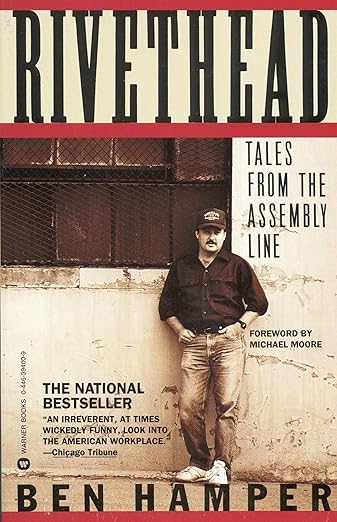
Rivethead: Tales from the Assembly Line (Ben Hamper) – Flint Book of the Week
Rivethead is Ben Hamper’s darkly hilarious, brutally honest memoir about life as a “shop-rat” on General Motors’ assembly lines in Flint, Michigan. It captures the culture, chaos, humor, and despair of factory work in the 1970s and 1980s, told in Hamper’s signature voice—sharp, sarcastic, and unsparing.

The book opens with Hamper’s childhood in a big Catholic family where generations of men worked at GM. Flint is portrayed as a city totally dependent on the auto industry—a place where the factory wasn’t just a job, it was destiny. Hamper grows up understanding that all roads lead to “the line.”

Hamper eventually ends up in the Truck & Bus plant, carrying on the family tradition he swore he’d avoid. He meets an unforgettable cast of co-workers, each coping with the repetitive, soul-grinding work in their own way—through pranks, drinking, jokes, drugs, or sheer stubbornness.

Hamper captures the rhythm of the assembly line:
•	The endless repetition
•	The impossible quotas
•	The absurd rules
•	The camaraderie among workers
•	The management-worker tension
•	Shop-Floor Culture

One of the book’s strongest threads is the bizarre, almost surreal world of shop-floor life.

Hamper describes:
•	“How to Build a Truck While Drunk”
•	Creative ways workers beat boredom
•	Breakroom politics and personalities
•	The legendary “Rivet Line” where he becomes known for his speed, sarcasm, and occasional rebellion

His descriptions are both comedic and bleak, painting the auto plant as equal parts factory and circus.

As production speeds up and layoffs loom during the 1980s economic downturn, the job becomes harder to endure. Hamper experiences severe panic attacks, stress breakdowns, and worsening anxiety—conditions exacerbated by GM’s instability and the collapse of Flint’s economy.

A memorable section documents his time under medical review, where the company doctors largely misunderstand the reality of mental strain on factory workers.

While working at the plant, Hamper begins writing columns for the Flint Voice / Michigan Voice—pieces that satirize GM and the absurdity of shop life. Michael Moore recognizes the power of Hamper’s voice and encourages him to continue.

Hamper’s writing eventually gains national attention, leading to work with Mother Jones. As his writing career grows, his life on the line becomes increasingly intolerable—leading to his final exit from the factory after a breakdown.

Rivethead ends without triumph or tidy resolution. Hamper leaves GM but continues to grapple with the aftereffects of factory life.

The book stands as:
•	A comedic but honest look at blue-collar America
•	A chronicle of Flint’s industrial unraveling
•	A rare insider’s voice on labor, class, and dignity
•	It is often considered one of the most important American labor memoirs of the late 20th century.

Notable Events in Rivethead
1)	The Opening: Growing Up in a Flint Factory Family:
Hamper’s description of his chaotic Catholic household—with alcoholism, noise, children everywhere, and a father constantly laid off or returning to GM—is unforgettable. It sets the tone: factory life is inherited like a family curse.

2)	“School Bus to Hell” — Starting Work at GM:
Hamper’s first days at General Motors are both frightening and hilarious. He describes walking into the plant like entering a steel jungle—roaring machines, sparks, rivers of sweat, and an atmosphere of total controlled chaos. His reaction is priceless: a mix of dread, awe, and “Well… I guess this is my life now.”

3)	The Rivet Line — His First Full-Blown Panic Attack:
During a shift on the line, Hamper suddenly feels the walls closing in—sweaty, dizzy, terrified. He doesn’t know what’s happening yet (panic disorder), and his co-workers treat it like a weird moment of shop-floor comedy. This scene is both tragic and darkly funny, capturing how mental health was ignored in factory culture.

4)	“How to Build a Truck While Drunk”:
One of the most quoted sections. Hamper describes the elaborate, creative ways workers would drink on the job:
•	Bottles hidden in toolboxes
•	“Coolant cocktails”
•	The legendary drinkers who could out-work sober men
It’s outrageous, reckless, and perfectly captures the “survival by absurdity” ethos of the plant.

5)	 The Shop-Rat Personalities — Dougie, Dale, and the Crew:
•	Hamper introduces a cast of unforgettable characters:
•	Dougie, who sings country songs loud enough to drown out the machinery
•	Dale, the speed-demon worker who runs his station like a man possessed
•	Various lifers, slackers, troublemakers, and geniuses of barely-controlled anarchy
These portraits are some of the book’s funniest, warmest sections.

6)	Playing “Rivet Hockey” in the Aisles:
Hamper describes factory workers using metal rivets as hockey pucks, turning the assembly line into a full-contact underground sport. It’s a perfect example of how boredom turns into creativity (and borderline stupidity), and how the workers battled the monotony any way they could.

7)	Bantering with Management During Inspections:
When GM executives tour the plant, Hamper and his co-workers pull out their best sarcastic jokes, feigned professionalism, and absurd antics. The workers’ razor-sharp mockery of management’s cluelessness is one of the book’s most pointed themes—and is wickedly entertaining.

8)	Hamper’s Breakdown and Forced Medical Leave:
When Hamper’s panic disorder worsens, he’s sent to see company doctors. These scenes are both heartbreaking and darkly comic:
•	The doctor who barely listens
•	The psychologist who tries to treat factory-induced trauma with clichés
•	GM’s inability to understand the mental cost of the line
This becomes a turning point in the book.

9)	Writing for Mother Jones and the Clash with Editor Adam Hochschild:
Hamper’s conflict with Mother Jones editor-in-chief Adam Hochschild leads to the famous firing of Michael Moore. Hamper describes it with biting humor and righteous anger—his first taste of the political tensions of the writing world.

10)	The Scene Where He Finally Walks Away from GM:
One of the most powerful moments: Hamper, worn down by panic attacks and years of factory life, simply cannot go back. He describes standing outside the plant—knowing if he steps inside, he’ll break again. The emotional weight is enormous. It isn’t triumphant. It’s not happy. It’s honest.

Ben Hamper
Ben Hamper (born 1956) is an American writer, music commentator, humorist, and former General Motors assembly-line worker from Flint, Michigan, best known for his gritty, funny, and unflinchingly honest memoir Rivethead: Tales from the Assembly Line.

Hamper grew up in Flint in a large, working-class Catholic family with deep ties to the auto industry. Multiple generations of Hampers worked the line, and Ben himself began taking factory jobs right after high school, eventually settling into the truck assembly plant in Flint. His early life and family dynamic—marked by blue-collar survival, hard drinking, and a sardonic humor—would later become the foundation of his writing.

Hamper spent the 1970s and 1980s in various GM plants, most notably the Truck & Bus plant.

His time in the "shop-rat" world shaped his worldview:
•	The monotony of repetitive labor
•	The culture of stress, pranks, drinking, and survival
•	The collapse of Flint’s auto economy

He wrote about these experiences not with anger alone but with a biting, comedic edge that made his work stand out.

Hamper began writing pieces for the Flint Voice, later the Michigan Voice, both edited by journalist Michael Moore. Moore recognized Hamper’s raw, compelling voice and encouraged him to write more.

Hamper’s columns eventually drew national attention, leading him to contribute to Mother Jones magazine (also during Moore’s tenure there).
His breakthrough came with the publication of Rivethead: Tales from the

Assembly Line, a memoir chronicling:
•	His family’s generational connection to the factories
•	His own years on the assembly line
•	The insanity and dark humor of factory culture
•	The declining industrial Midwest

The book became a major success—funny, bleak, and socially insightful. It is now considered a classic of working-class American literature.

A planned film adaptation (with Moore attached) stalled after the initial development phase, but the book has remained in print and widely taught.

After Rivethead, Hamper continued writing and exploring media projects:
•	Contributed to Mother Jones and regional publications
•	Appeared in Michael Moore’s documentary Roger & Me
•	Appeared in other Moore-related projects
•	Hosted radio shows, most recently “Soul Possession” on Flint public radio
•	Wrote music reviews and cultural commentary
•	Published the book The Rivethead Collected (an anthology of earlier shorter works)

Though he struggled with panic attacks and factory-related PTSD, Hamper remained a strong chronicler of industrial decline and working-class identity.

Ben Hamper is widely admired for:
•	His razor-sharp humor
•	His working-class authenticity
•	His portrayal of the emotional and economic realities of Flint
•	His ability to balance critique with compassion and absurdity
•	He is often placed alongside Studs Terkel and Charles Bukowski for his raw, colloquial, unvarnished storytelling.

 Ramblings of an Old Coot