Creative poems, thought and writings. Complaints. Insights. And more…
Recollections of a Michigan Boyhood (Charles A. Branch) – Flint Book of the Week
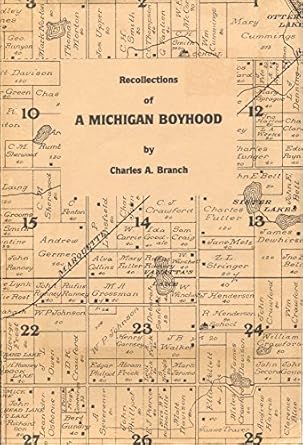
Recollections of a Michigan Boyhood by Charles Andrew Branch, edited by Robert G. Schafer, was published by the University of Michigan–Flint Archives (in cooperation with the Genesee County Historical Society) in 1983; the edition runs ~162 pages.

This is a first-person rural memoir: Branch pieces together a lifetime of memories about growing up in Genesee County and nearby Michigan communities, recording family history, pioneer arrivals, and everyday life on farms and in small towns. The narrative moves between larger family/settler lore (how the Branch and related families reached Michigan) and tightly observed vignettes of boyhood — chores, play, school, church, seasonal work, animals, and the local economy (gristmills, sawmills, railroads).

The book reads as an affectionate, detail-rich oral history: anecdotal, plainspoken, and focused on material culture and community relationships. Major themes are continuity of family and place, the practical rhythms of farm life, the role of churches and schools in small communities, the impact of railroads and logging on local life, and the small incidents that shape memory (holidays, funerals, local characters). Branch’s sketches often emphasize sensory detail (animals, weather, food, tools) and the network of neighbors and relatives that anchored rural Michigan life.

The table of contents shows sections such as The Branches Reach Michigan, Arrival in Genesee County of the Haywoods the Merriams, Earliest Recollections, plus later chapters on local places (Columbiaville, Otisville, Otter Lake), institutions (Flint High School, Pere Marquette railroad), and family gravesites and cemeteries.

Notable Moments in Recollections of a Michigan Boyhood (Charles A. Branch)
1.	“The Branches Reach Michigan” — family arrival and pioneer stories
Early chapters recount how the Branch (and related) families settled in Michigan: travel to the region, land claims, and the practical struggles and small victories of early settler life. These passages read like a family genealogy turned into lived memory, showing how place and lineage shape the narrator’s boyhood.

2.	Arrival of other local families (Haywoods, Merriams)
Branch devotes space to the arrivals and role of other named families (Haywoods, Merriams), describing how intermarriage, neighborliness, and local reputation tied the rural community together.

3.	“Earliest Recollections” — everyday boyhood scenes
The memoir’s central, scene-rich material: chores (milking, feeding animals), play and school, walking to town, wagons and buggies, seasonal work (planting/harvest), and the small details (food, clothing, tools) that mark life on a Michigan farm.

4.	Railroad and depot episodes (Pere Marquette / local depots)
Branch repeatedly mentions the local railroad (Pere Marquette) and depot life — arrival of trains, freight and passengers, and how the railroad reshaped community connections and commerce.

5.	Logging, sawmills, gristmills and the woods
Several chapters treat the region’s timber economy: logging camps, sawmill work, transporting logs, and how those industries affected local employment and landscape.

6.	Local places and small towns — Columbiaville, Otisville, Otter Lake
Branch gives episodic portraits of nearby towns and their institutions (stores, churches, schools, cemeteries), which serve as anchors for particular recollections.

7.	Church, school, holidays, and community rituals
Recurrent scenes show the social role of the Methodist/other churches, school experiences (including Flint High School references), holiday celebrations (Christmas, funerals), and how communal rituals structured childhood memory.

8.	Cemetery, gravesites, and family memory
The book closes on or returns to cemeteries and gravesites (e.g., Smith Hill Cemetery), using visits and family burial plots as moments of reflection on family continuity, mortality, and communal memory.

Charles Branch
Charles Andrew Branch (b. 1892) was a Michigan native whose surviving published legacy is a first-person memoir, Recollections of a Michigan Boyhood. The book is a richly detailed local memoir that preserves memories of farm life, small-town institutions, and community networks in Genesee County and nearby Michigan towns (notably Columbiaville, Otisville, and Otter Lake). Branch’s recollections emphasize family migration and settlement, the daily rhythms of chores and school, the influence of logging/sawmill and railroad economies, and community rituals (church, holidays, funerals, and cemetery visits). His memoir is preserved in the University of Michigan.
 Ramblings of an Old Coot