Creative poems, thought and writings. Complaints. Insights. And more…
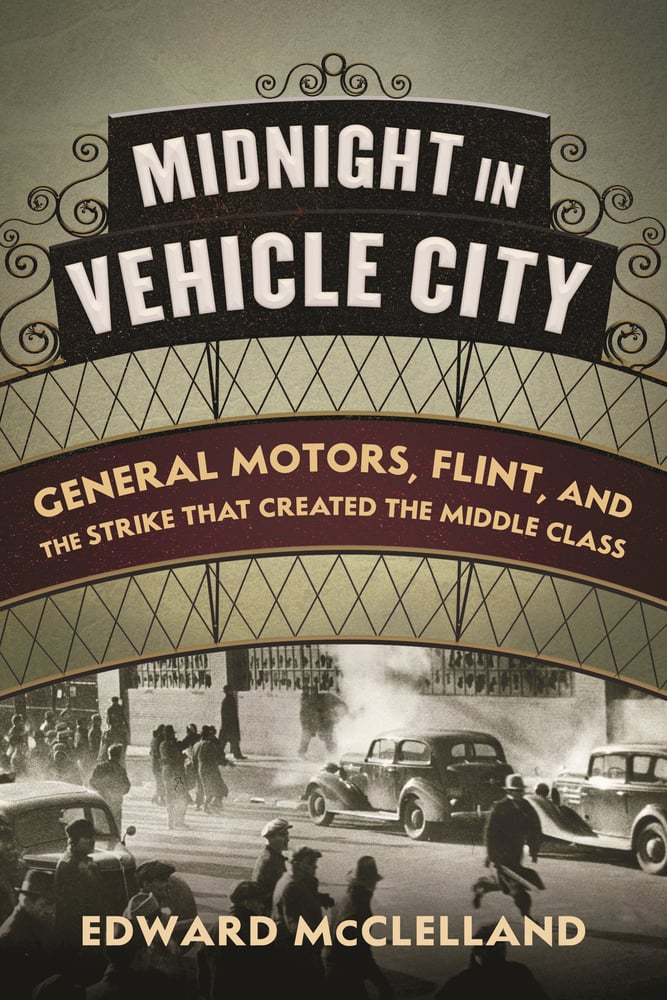
Midnight in Vehicle City: General Motors, Flint, and the Strike That Created the Middle Class by Edward McClelland – Flint Book of the Week
Midnight in Vehicle City is a narrative history of the 1936–1937 Flint Sit-Down Strike, a pivotal labor action that transformed American industry and helped give rise to the modern middle class. Centered in Flint, Michigan—also known as “Vehicle City” and the heart of General Motors’ manufacturing empire—the book chronicles how ordinary auto workers challenged one of the most powerful corporations in the world and permanently altered the balance of power between labor and management.

McClelland traces the harsh working conditions inside GM plants during the Great Depression: grueling hours, arbitrary firings, speed-ups, unsafe environments, and the company’s aggressive anti-union tactics. Against this backdrop, workers affiliated with the newly formed United Auto Workers (UAW) adopted a radical strategy—the sit-down strike—by occupying GM factories and refusing to leave, preventing the company from bringing in replacement labor.

The narrative follows the escalating confrontation between workers, GM executives, local authorities, and Michigan Governor Frank Murphy, whose refusal to use military force against the strikers proved decisive. The book vividly recounts dramatic episodes such as the “Battle of the Running Bulls,” when police attempted to retake a plant using tear gas and gunfire, only to be repelled by strikers armed with improvised weapons.

Ultimately, the strike forced General Motors to recognize the UAW, setting a precedent that rippled across American industry. McClelland argues that this moment marked a turning point in U.S. labor history, laying the groundwork for collective bargaining, higher wages, job security, and benefits that would define the American middle class in the decades after World War II.

Blending social history, political analysis, and on-the-ground storytelling, Midnight in Vehicle City presents Flint not only as a battleground between labor and capital, but as a symbol of how grassroots organizing reshaped the nation’s economic and social structure.

Notable events in Midnight in Vehicle City

1. The Launch of the Flint Sit-Down Strike (December 30, 1936)
United Auto Workers members initiated an unprecedented labor tactic by occupying key General Motors plants in Flint, most importantly Fisher Body Plant No. 1. Rather than walking out, workers remained inside the factories, preventing GM from using replacement labor or moving machinery. This bold strategy immediately paralyzed GM’s production nationwide and forced the conflict into the public spotlight.

2. General Motors’ Legal and Political Counteroffensive
GM responded with court injunctions, pressure on local officials, and aggressive public-relations campaigns portraying the strikers as radicals and criminals. The company sought to have the National Guard or police forcibly remove workers from the plants. These maneuvers reveal the immense corporate power GM wielded—and the high stakes of the confrontation.

3. The “Battle of the Running Bulls” (January 11, 1937)
Flint police attempted to retake Fisher Body Plant No. 2 using tear gas and gunfire. Strikers resisted with fire hoses, thrown objects, and makeshift weapons, forcing the police to retreat. The violent clash resulted in injuries on both sides and became the most iconic episode of the strike, symbolizing workers’ willingness to physically defend their right to organize.

4. Governor Frank Murphy’s Intervention
Michigan Governor Frank Murphy refused GM’s demands to use the National Guard to break the strike. Instead, he deployed Guard units to prevent violence and protect the strikers from eviction. His decision marked a critical shift: state power would not automatically side with corporate interests, allowing the strike to continue and negotiations to proceed.

5. General Motors Recognizes the UAW (February 11, 1937)
After 44 days, GM formally recognized the United Auto Workers as the exclusive bargaining representative for its employees. This landmark victory legitimized industrial unionism in the auto industry and triggered a wave of successful organizing across American manufacturing, helping establish wages, benefits, and job security that formed the backbone of the mid-20th-century American middle class.

Edward McClelland
Edward McClelland is an American journalist and author known for his accessible, narrative-driven examinations of labor, class, and urban history in the United States. His work often focuses on the intersection of industrial capitalism, working-class activism, and the long-term social consequences of economic policy. McClelland combines traditional historical research with journalistic storytelling, making complex labor struggles intelligible to a broad readership.

He has written extensively about Midwestern cities—particularly Flint, Detroit, and Chicago—using them as case studies to explore national trends in unionization, deindustrialization, and the rise and decline of the American middle class.

Notable Works
•	Midnight in Vehicle City: General Motors, Flint, and the Strike That Created the Middle Class (2016)
A narrative history of the 1936–1937 Flint Sit-Down Strike, detailing how autoworkers forced General Motors to recognize the United Auto Workers, reshaping American labor relations and laying the foundation for postwar middle-class prosperity.

•	Young Mr. Obama: Chicago and the Making of a Black President (2011)
An exploration of Barack Obama’s formative years in Chicago, emphasizing the city’s political culture and grassroots organizing traditions.

•	How Progressive Was Wisconsin? (2014)
A reassessment of Wisconsin’s Progressive Era legacy and its contradictions, particularly regarding labor and political reform.

While not a native of Flint, McClelland’s Midnight in Vehicle City stands as one of the most prominent modern historical accounts of Flint’s central role in American labor history. The book has become a frequently cited secondary source in discussions of Flint’s industrial legacy and the origins of the American middle class.

 Ramblings of an Old Coot