Creative poems, thought and writings. Complaints. Insights. And more…
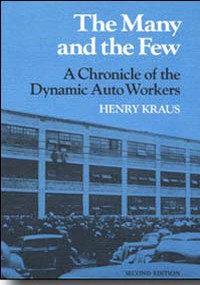
The Many and the Few: A Chronicle of the Dynamic Auto Workers by Henry Kraus – Flint Book of the Week
The Many and the Few is an insider’s chronicle of the pivotal United Automobile Workers (UAW) sit-down strike against General Motors in Flint, Michigan in 1936–1937, a defining moment in American labor history. The author, Henry Kraus, was himself a UAW activist and editor deeply involved in the events he recounts, giving the narrative both immediacy and personal insight.

Over the course of the book, Kraus:
•	Recounts the buildup to the strike, set against the backdrop of the Great Depression, economic hardship, and the rise of industrial unionism.
•	Details how auto workers at General Motors plants in Flint initiated and sustained a six-week sit-down strike, occupying factory facilities and refusing to let management resume production. This tactic was relatively novel at the time and critically effective because it prevented GM from simply replacing strikers with other workers.
•	Shows how the strike forced General Motors to negotiate, ultimately leading the company to recognize the UAW as the exclusive bargaining representative for its workers — a landmark victory that helped transform the UAW from a fringe organization into a major national union.
•	Focuses on the rank-and-file workers (“the many”) and the smaller cadre of organizers (“the few”), portraying their solidarity, struggles, and strategic maneuvers as they faced immense pressure from both corporate opposition and internal union politics.

Because Kraus participated in the events he describes, the book blends firsthand narrative with historical analysis. It emphasizes the experiences and collective actions of ordinary workers, as well as the strategic decisions and challenges faced by organizers, rather than just abstract institutional developments.

The book documents a turning point in U.S. labor history: the Flint sit-down strike not only secured union recognition at GM but also helped propel the UAW into one of the most powerful labor unions in the country.
As both a participant and historian, Kraus offers a unique blend of eyewitness reporting and labor movement analysis.

Henry Kraus (1905–1995)
Born: November 13, 1905 — Knoxville, Tennessee, USA
Died: January 27, 1995 — Paris, France

Kraus was born to parents active in labor unions and raised in Cleveland, Ohio, after his family moved there in his youth.  He attended the University of Chicago briefly, then earned a B.A. (1926) and M.A. (1927) from Western Reserve University (now Case Western Reserve University).

He met his wife, Dorothy Rogin Kraus, in high school; she was a Polish-born Jewish socialist and later an activist in her own right.

Kraus became active in labor organizing in the 1930s, particularly among automobile workers in Cleveland.  He moved to Detroit in 1936 as the labor movement expanded, where he founded and edited the UAW’s national newspaper, The United Auto Worker.

Kraus was deeply involved in organizing during the critical years of the United Automobile Workers (UAW) and played an organizing role in the 1936–1937 Flint sit-down strike against General Motors — a pivotal moment in U.S. labor history.

He also edited The Flint Auto Worker and worked on other union publications.
In 1937, UAW President Homer Martin fired him amid internal union factional struggles related to political influences and leadership battles.

After leaving union work, Kraus faced employment challenges amid Cold War politics and accusations of communist sympathy.

He worked as a medical correspondent in Europe and ultimately settled in Paris, where he focused on medieval art and cathedral studies.

With his wife Dorothy, he published several works on medieval art and architecture, including Gold Was the Mortar: The Economics of Cathedral Building and studies on misericords and choirstalls.

In 1984 he received a MacArthur “Genius” Fellowship for his contributions to art history and scholarship.

Publications:
The Many and the Few: A Chronicle of the Dynamic Auto Workers (1947)
Heroes of Unwritten Story: The UAW, 1934–39 (1993)
In the City Was a Garden: A Housing Project Chronicle (1951)

 Ramblings of an Old Coot