Creative poems, thought and writings. Complaints. Insights. And more…
Owen Rhoscomyl by John S Ellis – Flint Book of the Week
This weeks book has no ties to Flint, other than the fact its author, a Fulbright Scholar, John Stephen Ellis is a Professor of History at the University of Michigan-Flint.

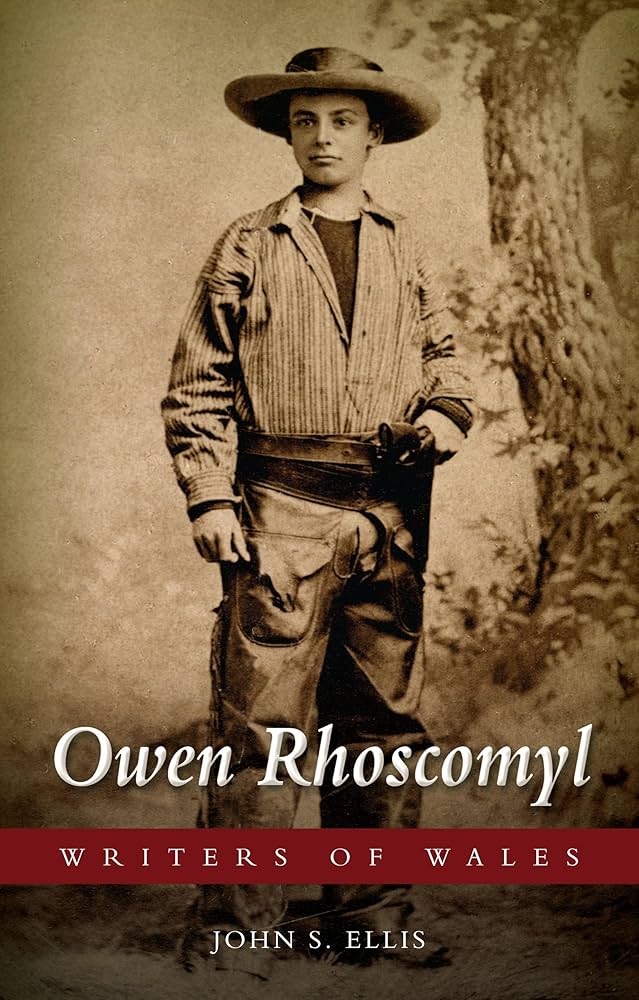
In this 2016 biography, Owen Rhoscomyl (part of the "Writers of Wales" series by the University of Wales Press), John S. Ellis provides a literary and historical deep dive into one of Wales' most eccentric and "forgotten" figures.

Owen Rhoscomyl (1863–1919) was the pseudonym of Robert Scourfield Mills, a man whose life read like the adventure novels he eventually wrote. Before becoming a writer, he was a:
•	Cowboy and Frontiersman: He spent years in the American West and Patagonia.
•	Mercenary and Soldier: He fought in the Boer War and rose to the rank of Colonel in World War I.
•	Propagandist: He was a fierce advocate for Welsh national identity.

Ellis explores how Rhoscomyl used his writing to reinvent the image of the Welsh people.
•	At a time when the Welsh were often stereotyped as "effeminate" or "defeatist" (focused mostly on poetry and religion), Rhoscomyl depicted them as a rugged, masculine, and warrior race. He drew parallels between the Welsh mountains and the lawless frontiers of the American West.
•	Ellis highlights Rhoscomyl's unique "Imperial Patriotism." He believed that the Welsh could be both fiercely nationalistic and loyal to the British Empire, arguing that Welsh "martial vigor" made them the perfect soldiers for the Empire's frontier.
•	The biography doesn't shy away from Rhoscomyl’s darker side. Ellis portrays him as a man of "vaulting ambitions" but also "bitter disappointments," dealing with poverty, a fiery temper, and a life of delinquency before finding fame as a writer.
•	Ellis positions Rhoscomyl as a man attempting to do for Wales what Walter Scott did for Scotland—reclaiming the "glories of the past" through historical romance and public spectacle to inspire a modern national pride.

Ellis argues that while Rhoscomyl's prose was often "florid" and his characters "cardboard" by modern standards, he was an influential pioneer in Welsh writing in English. The book examines how Rhoscomyl’s own life—as a self-made hero—was his greatest work of fiction.

John Stephen Ellis is a Professor of History at the University of Michigan-Flint within the Department of Social Sciences and Humanities. He is a specialist in modern British and Irish history, with a particular focus on national identity, Celtic studies, and royal ceremony.
Professor Ellis has an extensive academic record, having served at several institutions before joining UM-Flint in 2002.

•	He earned his Ph.D. in History in 1997. He also holds degrees from Eastern Michigan University (1990) and has studied at the University of Wales, Aberystwyth.
•	He was a Fulbright Scholar at the University of Wales in the mid-1990s.
•	Professional Path: Prior to UM-Flint, he held faculty positions at Green Mountain College and Boston College.

His work often explores how rituals and traditions shape national identity in the British Isles.
•	He is the author of Investiture: Royal Ceremony and National Identity in Wales, 1911–1969 (2008), which examines the symbolic role of the Prince of Wales.
•	His expertise includes: Modern Britain and Ireland, Welsh history and identity, and The Celtic origins of modern traditions (e.g., he has lectured on the origins of Halloween/Samhain).
o	Immigration and ethnic history (he has contributed to museum exhibitions on Welsh immigration to the U.S.).
 Ramblings of an Old Coot