Creative poems, thought and writings. Complaints. Insights. And more…
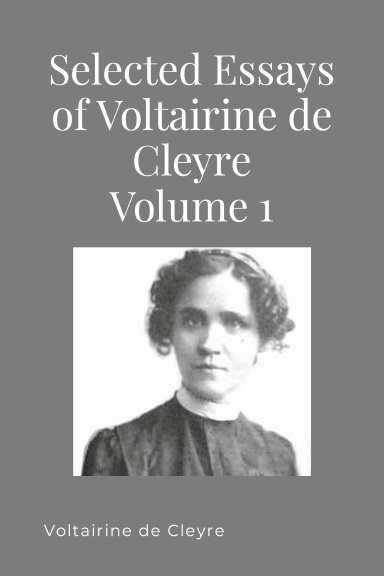
Selected Essays of Voltairine de Cleyre Volume 1 by Voltairine De Cleyre – Rostie Publishing
Voltairine de Cleyre was one of the most versatile and radical thinkers in American history. Often overshadowed by her contemporary Emma Goldman, de Cleyre’s essays are noted for their poetic intensity, intellectual rigor, and a distinct "anarchism without adjectives."
1. Anarchism Without Adjectives De Cleyre’s most significant contribution to political theory was her refusal to get bogged down in sectarian disputes between different schools of anarchism (like individualist vs. communist). • The Core Idea: She argued that as long as people are free and uncoerced, they should be allowed to experiment with whatever social or economic systems work for them. • Tolerance: She advocated for a "big tent" approach, focusing on the abolition of the state rather than enforcing a specific economic blueprint.
2. Direct Action In her famous essay Direct Action, she demystified the term, arguing that it wasn't synonymous with violence. • Everyday Resistance: She defined direct action as any action taken by individuals or groups to achieve their goals without the mediation of the government or legal systems. • Examples: This included everything from strikes and boycotts to the simple act of a person refusing to comply with an unjust social norm.
3. Feminism and "The Marriage Question" De Cleyre was a fierce critic of the domestic subordination of women. In essays like The Gates of Freedom and The Case of Woman vs. Orthodoxy, she explored: • Sexual Autonomy: She argued that true freedom was impossible as long as women were economically and legally dependent on men. • Marriage as Slavery: She famously critiqued the institution of marriage of her time as a form of "legalized rape" and "domestic bondage," advocating instead for "free unions" based on mutual affection rather than legal contracts.
4. The Critique of Authority Her writing often targeted the psychological roots of why people obey. • Religious Institutions: She viewed the Church as a primary tool for keeping the masses submissive. • The State: She saw the government not as a protector, but as a parasite that enforced class distinctions and protected the wealthy at the expense of the laborer.
Voltairine de Cleyre (1866–1912) Born April 12, 1866, Leslie, Michigan, USA Died June 20, 1912, Chicago, Illinois, USA (due to kidney failure)
Anarchist essayist, orator, poet, and leading figure in American individualist and non-sectarian anarchism. Thomas Paine, Henry David Thoreau, Mary Wollstonecraft, and the Haymarket Affair.
Voltairine de Cleyre was one of the most eloquent and influential thinkers in the history of American anarchism.
Born in Michigan, she was named after the Enlightenment philosopher Voltaire. Her father, a physician, placed her in a Catholic convent school in Sarnia, Ontario, which she intensely disliked, fostering in her a lifelong commitment to anti-clericalism and free thought. She initially joined the burgeoning freethought movement, but her political views rapidly radicalized following the Haymarket Affair in 1887. The execution of the Haymarket anarchists, whom she believed were martyrs of state repression, transformed her from a liberal freethinker into a staunch anarchist.
De Cleyre initially aligned with Individualist Anarchism but evolved to advocate for "Anarchism Without Adjectives," a tolerant, non-dogmatic stance that accepted various economic systems (mutualism, collectivism, communism) provided they were based on voluntary association and freedom from state coercion. She wrote extensively on individual liberty, economics, and religion. Her most famous essays include "The Dominant Idea," which explores how a single, powerful conviction shapes a person's life, and "Anarchism," a definitive statement on her philosophy.
De Cleyre was a fierce proponent of women’s rights, identifying marriage as a form of "sex slavery" and criticizing the societal structures that oppressed women both economically and sexually. She was also deeply engaged in labor movements, spending many years living and teaching English to Jewish immigrant workers in Philadelphia.
Despite battling chronic illness (which ultimately led to her death at age 46) and surviving an attempted assassination in 1902, she remained a prolific writer and powerful orator. Though often overlooked during her life, her posthumously collected works secured her position as a foundational figure whose blend of impassioned prose and intellectual rigor continues to inspire radical thought.
Table of Contents: The Dominant Idea Anarchism Anarchism and American Traditions Anarchism In Literature The Making of an Anarchist The Eleventh of November, 1887 Crime and Punishment In Defense of Emma Goldman and the Right of Expropriation About Voltairine de Cleyre
 Ramblings of an Old Coot