Creative poems, thought and writings. Complaints. Insights. And more…
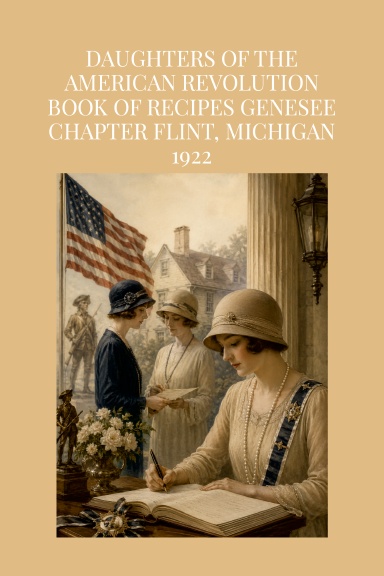
DAUGHTERS OF THE AMERICAN REVOLUTION BOOK OF RECIPES GENESEE CHAPTER FLINT, MICHIGAN 1922
The Genesee Chapter of the Daughters of the American Revolution (DAR) Organized in Flint, Michigan, on June 10, 1897. As one of the oldest chapters in the state, it served as the primary social and civic anchor for women who could prove direct lineage from soldiers or patriots of the American Revolution.
By 1922, the chapter had evolved from a small genealogical society into a powerhouse of "Civic Motherhood," focusing on historical preservation and the rapid social changes brought by Flint’s industrial boom.
The DAR in Flint: 1922 Focus Areas In 1922, the Genesee Chapter was under the leadership of Regent Mrs. Fred W. (Harriet) Thompson. Their activities that year were defined by three main pillars:
1. Americanization of Immigrants Flint’s population was exploding due to the growth of General Motors. In 1922, the DAR was heavily involved in "Americanization" schools. a. They distributed "The Manual for Immigrants" (often in multiple languages) to workers in the factories. b. They hosted citizenship classes to teach English and American history to the families of foreign-born laborers.
2. Post-WWI Memorialization a. With the Great War having ended only four years prior, the 1922 committee was obsessed with record-keeping. b. The chapter worked to compile a "Military Record of Genesee County," documenting the service of local men in WWI. c. They provided financial support to the Roosevelt Memorial Association and local veterans' hospitals.
3. Marking the "Grand Traverse" and Pioneer History a. The DAR viewed themselves as the guardians of Flint's origin story. In the early 1920s, they were physically marking the landscape: b. The Grand Traverse: They maintained and promoted the significance of the "Grand Traverse of the Flint," the shallow spot in the river used by Native Americans and early traders like Jacob Smith. c. Pioneer Graves: They conducted "Grave Markings" for the few remaining Revolutionary War veterans who had migrated to Michigan in the early 1800s and were buried in local cemeteries like Glenwood or Avondale.
Social Influence and Membership: In 1922, the DAR was not just a history club; it was a status symbol. Membership was composed of the wives and daughters of Flint’s elite—doctors, factory executives, and pioneer families (like the Potter, Frisbie, and Locy families).